
Trade Tensions and India’s Growth Outlook: Navigating the Crosswinds
- admin
- October 24, 2025
- Economic Trends, Global Market
- 0 Comments
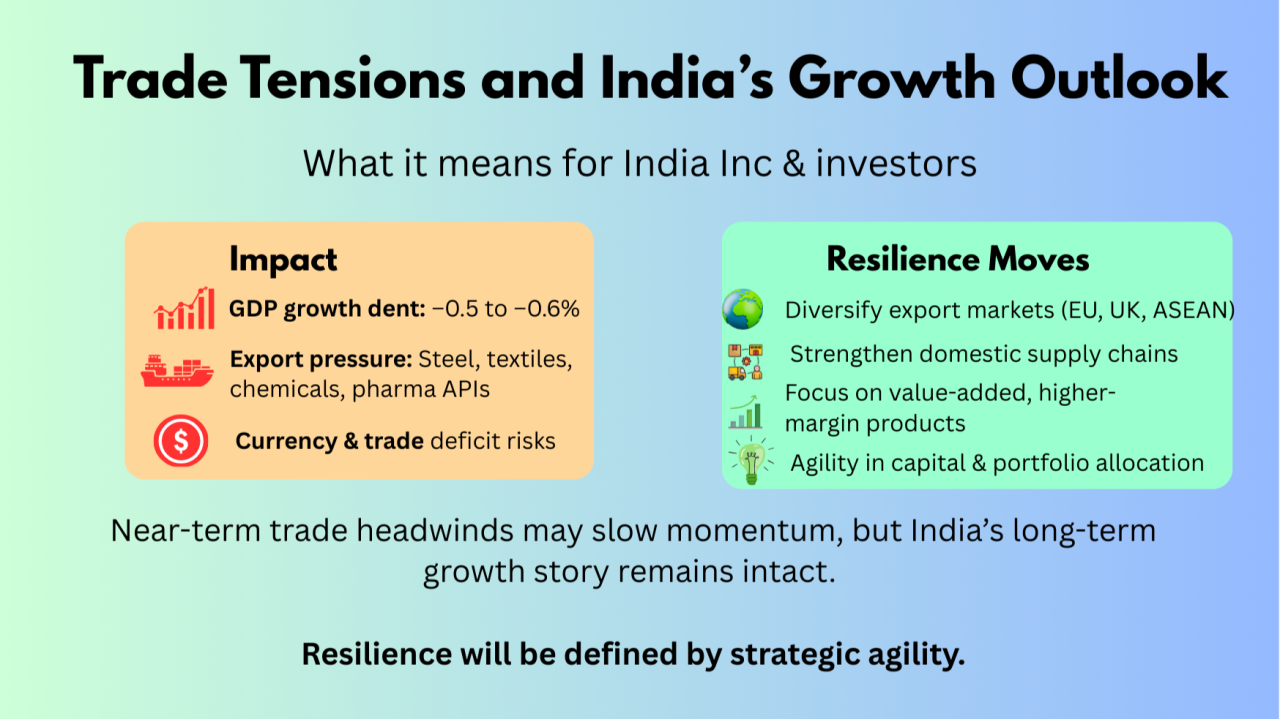
India’s Chief Economic Adviser, V. Anantha Nageswaran, recently cautioned that new U.S. tariffs, some as high as 50%, could shave 0.5–0.6% off India’s GDP growth in 2025. While this may seem like a modest adjustment against a projected growth rate of ~6.5%, the implications reach far deeper. Global trade realignments are not just short-term speed bumps; they represent structural forces that can reshape supply chains, capital flows, and corporate strategies.
The question, then, is not whether India will continue to grow; the fundamentals remain strong, but how resiliently it will navigate these headwinds.
The Macro Lens: Growth, Trade, and Stability
- GDP Impact A 0.5–0.6% dent in growth translates into billions of dollars in lost output. Beyond the number, this reflects pressure on export sectors that have traditionally contributed significantly to industrial output and job creation.
- Balance of Payments Reduced export earnings could widen the current account deficit, especially if oil prices remain elevated. While India’s foreign exchange reserves are robust, a prolonged imbalance could weigh on the rupee.
- Inflationary Trends Tariffs may lead to cost-push inflation if companies reroute supply chains or absorb higher input costs. This could complicate monetary policy, as the RBI balances growth support with inflation management.
- Global Spillovers India is not alone. The tariff environment could trigger retaliatory measures, weaken global demand, and create uncertainty for multinational trade. This environment demands agility, not just resilience.
Sectoral Impact: Uneven Pressures
Export-Exposed Sectors (at risk):
- Textiles & Apparel: Already under margin pressure, tariffs could erode competitiveness.
- Chemicals & Pharma APIs: Vulnerable due to integration with U.S. supply chains.
- Metals & Steel: Price-sensitive and heavily dependent on global demand.
Moderately Exposed:
- Auto Components & Electronics: Integrated into global supply chains but with opportunities to diversify.
Resilient or Beneficiaries:
- FMCG & Domestic Consumer Goods: Insulated by local demand strength.
- IT & Services: Diversified global exposure cushions shocks.
- Agriculture & Agri-Tech: Potential to expand exports into new regions (Middle East, Africa).
This divergence highlights the importance of sector rotation strategies for both businesses and investors.
Implications for India Inc: Strategy Shifts Required
The trade headwinds present an opportunity — and a necessity — for Indian companies to rethink their strategic positioning.
Diversification of Export Markets
- Reliance on U.S. and China as primary trading partners creates vulnerabilities.
- Emerging FTAs with the EU, UK, and ASEAN provide avenues for risk distribution.
Domestic Supply Chain Strengthening
- The “Make in India” push gains fresh relevance.
- Localizing inputs and building vertically integrated ecosystems can reduce import reliance.
Value-Added Competitiveness
- Competing on cost alone is unsustainable.
- Investment in R&D, branding, and technology can help Indian exports move up the value chain.
Capital & Risk Management
- Companies must adopt currency hedging and financial restructuring to buffer volatility.
- Strategic allocation of capital towards resilient business lines will be critical.
The Investor Lens: Rethinking Portfolios
For investors, these developments reinforce the need for portfolio agility.
- Caution: Export-dependent sectors with thin margins are vulnerable to earnings downgrades.
- Opportunities: Domestic demand-driven plays (infrastructure, FMCG, renewable energy, digital economy) are better positioned for stability.
- Selective Bets: Firms that serve as import substitutes or occupy niches in global supply chains could see upside.
- Currency & Hedging: Investors must consider the rupee’s potential volatility and its impact on returns.
A balanced portfolio, blending resilience with growth, will be key.
The Policy Dimension
The government will need to balance short-term relief with long-term structural positioning. Possible responses may include:
- Accelerating FTA negotiations.
- Expanding PLI schemes to encourage domestic manufacturing.
- Enhancing export credit support for vulnerable industries.
- Strategic diplomacy at WTO and bilateral forums.
Policy clarity will be critical in maintaining investor confidence and ensuring India’s competitiveness in a shifting global order.
Looking Ahead: Resilience Through Agility
Trade tensions may dent near-term growth, but they do not derail India’s long-term trajectory. Demographics, digitalization, infrastructure investment, and consumption trends remain powerful tailwinds.
What will separate leaders from laggards is the ability to adapt strategically. For India Inc and its investors, resilience will no longer mean just absorbing shocks — it will mean reconfiguring strategies, reallocating capital, and reimagining global positioning.
In an age of uncertainty, agility is the new resilience.